Use case · Govern the AI You Find
Walk into the AI review with the register already done.
KeyCaliber records a decision on every AI system it finds, names the person accountable, scopes approval to the people it applies to, and keeps the history — ready to hand over as one dated file.
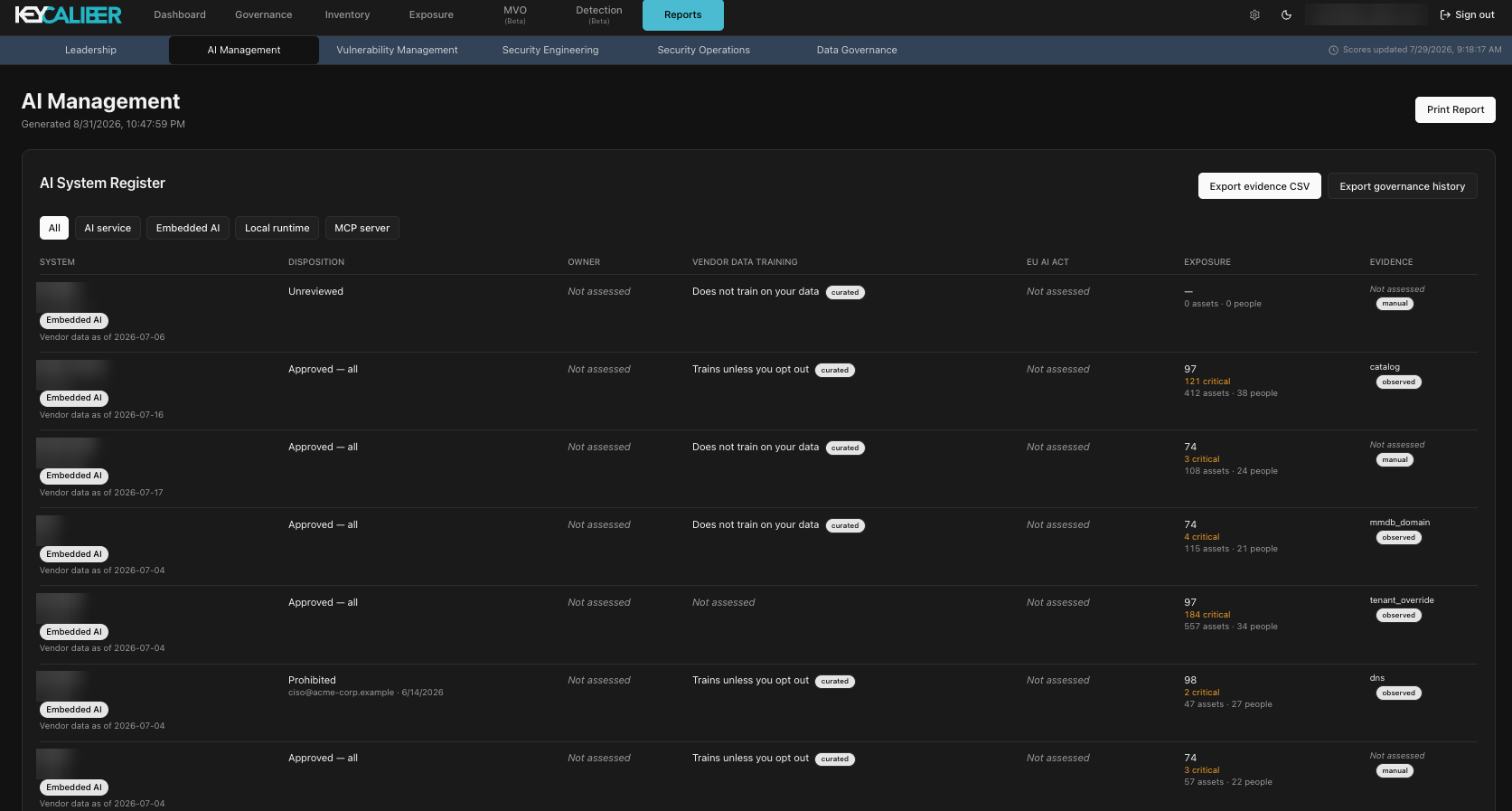
Demo environment · vendor names and account details redacted
What an auditor actually asks for.
Every column in the register answers something a framework asks a deployer to produce. Not a compliance verdict — the material the assessment is built from.
| Framework | What it asks a deployer to produce | What the register carries |
|---|---|---|
| ISO/IEC 42001 | An AI system register, supplier AI controls, inputs to an impact assessment, assigned accountability | Every system, its vendor, the named owner and who set it, the vendor's training policy and certifications, and what the system reaches |
| NIST AI 600-1 | Enumerate the organization's generative-AI systems; document third-party and value-chain components | Every system with the signal that found it and when, the models actually observed, and the vendor's own sub-processors |
| EU AI Act Art. 26 | Use per provider instructions, assign human oversight, monitor operation, keep records of use | The decision, who made it, when, the note behind it, who it was authorized for, and first and last seen |
| EU AI Act Art. 50 | Disclose AI interaction and AI-generated content | Which products in use ship AI features, and whether the vendor turns them on by default |
| NYDFS Part 500 | §500.13 asset inventory, §500.11 third-party policy, §500.7 access privileges | Assets and identities touching each system, how many hold admin, who it is authorized for, and the vendor's data posture |
One register. Four kinds of AI system.
AI does not arrive one way, so a register that only holds one kind is already incomplete on the day it is written.
Hosted AI tools
The AI services in use across the estate, found from traffic, DNS, gateway logs and sign-ins.
AI inside apps you already own
The AI features a vendor shipped into software you approved before it had any, and whether they arrive switched on.
AI running locally
Model runtimes installed on laptops and servers, read from the software inventory your EDR and MDM already collect.
AI agent connections
Remote MCP endpoints seen in the estate, each linked to the vendor app behind it — with that app's approval shown as inherited, because approving an app is not a review of agent access into it.
Every cell says where it came from.
Nothing in the register is asserted flat. Each value carries how it was arrived at: observed from your own telemetry, curated from our vendor catalog with the date it was reviewed, manual where somebody in your organization typed it, or not assessed where nobody knows yet.
Your vendor list stops at your vendors. Your data doesn't.
The vendor's own policy
An approved app whose vendor trains on submitted data is a different problem when it is reaching your payroll server than when it is reaching a marketing calendar. The register flags the ones reaching critical assets or admin accounts.
Where that reach can't be measured yet, the app says so. It does not show an all-clear it hasn't earned.
The vendors behind the vendor
Every vendor you approve has vendors of its own. Their sub-processor lists are public, and almost nobody reads them.
We read them, from each vendor's own page, and date what we find. Where a vendor publishes nothing — or publishes something we couldn't read — the record says which. It is never left blank.
The decision, and everything that changed it.
A register nobody has decided anything in is a spreadsheet with better provenance. The decision is the point.
Five states, not a checkbox
Unreviewed, Evaluating, Approved, Approved for some people, Prohibited — the states a real review actually passes through.
Approved for a group, not everyone
Authorize a tool for one team, and use outside that group resolves into a queue you can work.
A named owner
The business owner of every AI and SaaS app, recorded on the app, with who set it and when. It is the column every AI-governance framework asks for.
The whole history
Every approval, reversal, prohibition, review, owner change and scope change, with who did it and when. Decisions made before we started logging are reconstructed from their stamps and labelled as reconstructed, never presented as witnessed.
See what you'd be able to hand over.
Connect one endpoint tool and one network source. The register fills itself from what your tools already know.
Request a demo